Stomping the Ladder: How Smurf Accounts Are Quietly Killing Competitive Gaming's Future
Stomping the Ladder: How Smurf Accounts Are Killing Competitive Gaming's Future
There's a version of smurfing that gets romanticized constantly in competitive gaming circles. The veteran player, bored at the top, drops into low-ranked lobbies to "sharpen their mechanics" or "experiment with off-meta picks." Content creators frame it as entertainment. Some pros quietly justify it as a training tool. But underneath all those rationalizations sits an uncomfortable truth: smurfing is poisoning the very competitive ecosystem it pretends to nurture.
And the damage runs a lot deeper than a few frustrating matches for Bronze players.
What Smurfing Actually Looks Like in 2024
Smurfing isn't new. It goes back to the earliest days of online competitive gaming, named after two StarCraft players — Smurf and PapaSmurf — who created fake accounts to avoid being recognized. Decades later, the practice is everywhere: League of Legends, Valorant, Overwatch 2, Rocket League, CS2. You name the game, smurf accounts exist in it at scale.
The modern smurf isn't always a bored Diamond player either. We're talking about streamers with hundreds of thousands of followers queuing into Silver lobbies for reaction content. We're talking about actual professionals — people who compete on stages in front of live audiences — dropping into beginner-adjacent matchmaking to produce highlight reels. The incentive structure rewards it. Clips of a Grandmaster player going 40-2 in a Gold lobby get clicks. The algorithm doesn't care about matchmaking integrity.
And so the cycle keeps spinning.
The Fake Skill Mirror
Here's where the real problem starts. When a newer player — let's say someone six months into Valorant, genuinely trying to climb — repeatedly runs into smurfs, they're not just losing games. They're receiving completely corrupted feedback about their own development.
Think about what competitive ranking systems are supposed to do. They're designed to be mirrors. Win rate, KDA, positioning errors — all of it should reflect an honest picture of where your skill sits relative to players at a similar stage. Smurfing breaks that mirror completely. A Silver player getting demolished by someone who should be Radiant walks away thinking they made critical mistakes, that their fundamentals are broken, that they need to start over on mechanics they've actually already mastered.
That's not just demoralizing. It's actively misleading. The player doesn't learn from a legitimate loss — they learn the wrong lessons from an illegitimate one.
Multiply that across thousands of matches happening simultaneously in any given ranked queue, and you start to understand the scale of the distortion. The ladder stops functioning as an honest competitive environment. It becomes a minefield where actual skill growth gets confused with variance caused by account manipulation.
New Player Retention: The Number Nobody Talks About
Game publishers obsess over player acquisition. The marketing budgets, the free-to-play hooks, the seasonal content drops — all of it is designed to get new players in the door. What gets talked about far less publicly is what happens to those players after their first thirty hours.
Retention data across the industry consistently shows that new players who experience repeated early losses — especially losses that feel unwinnable — churn at dramatically higher rates. That's not surprising. What's underappreciated is how much smurfing contributes to those early experiences feeling exactly that way: unwinnable, confusing, and discouraging.
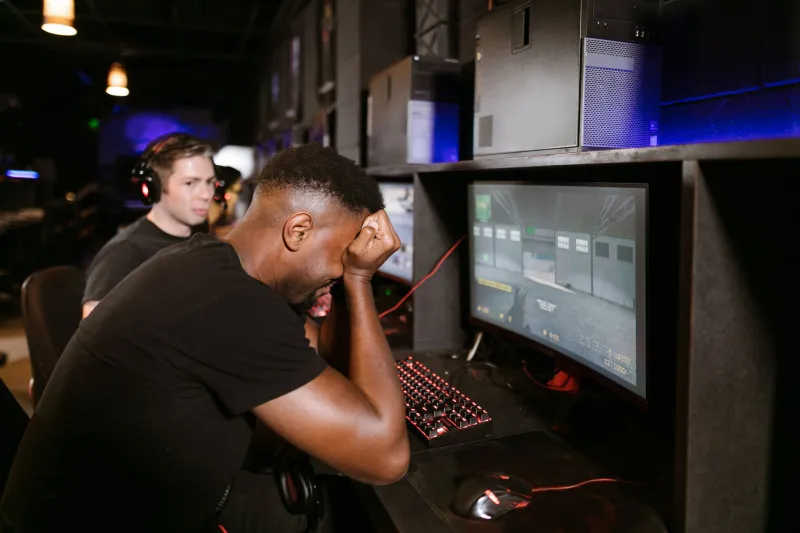
A new Rocket League player who queues into their first ranked season and gets repeatedly outclassed by someone with 4,000 hours hiding behind a fresh account isn't just losing games. They're concluding that the skill gap in this game is insurmountable. Many of them leave. They don't come back. That's a potential lifetime competitive player — someone who might have grinded for years, spent money on the game, maybe even developed into a legitimate prospect — gone because their early experience was artificially distorted.
The talent pipeline doesn't just get damaged at the top. It gets cut off at the roots.
The "I'm Helping" Myth
One of the most persistent justifications you'll hear from smurfs — especially content creator types — is that they're providing value to lower-ranked players. Showing them what "real" skill looks like. Giving them something to aspire to.
This argument falls apart almost immediately under any serious scrutiny.
Watching someone with five times your game hours absolutely dismantle your team doesn't teach you anything actionable. There's no lesson in getting one-tapped by a former pro who's operating on muscle memory developed over years of professional play. The skill gap isn't instructional — it's just a wall. And the players on the receiving end know it. They're not inspired. They're frustrated, sometimes to the point of quitting.
Legitimate skill development in competitive gaming comes from playing against opponents at roughly your level, making mistakes, recognizing those mistakes, and correcting them over time. That process requires an honest competitive environment. Smurfing directly undermines it.
What Enforcement Actually Looks Like (And Why It's Failing)
Riot Games, Blizzard, Psyonix — most major publishers have anti-smurf policies on paper. Valorant has implemented systems designed to accelerate rank placement for accounts showing high performance metrics. Overwatch 2 has made similar adjustments. These are real efforts, and they're not nothing.
But enforcement remains reactive rather than proactive. Detection systems catch obvious cases — accounts with suspiciously high win rates in low MMR brackets — but sophisticated smurfs know how to game placement matches, manage their stats, and avoid triggering automated flags. And when a popular streamer or known pro gets flagged, the PR calculus often gets complicated fast.
The harder truth is that smurf account enforcement sits at an awkward intersection of competitive integrity and content creator economics. Streamers who smurf drive viewership. Viewership means platform engagement. Platform engagement means partnership deals and promotional opportunities that publishers themselves benefit from. The financial incentives to look the other way are real, even if nobody says it out loud.
Stricter enforcement — think hardware-level bans, more aggressive behavioral detection, and public accountability for known repeat offenders — would require publishers to prioritize matchmaking integrity over short-term content ecosystem benefits. That's a harder call than it sounds.
What the Competitive Community Actually Deserves
At its core, ranked matchmaking is a promise. It's a system telling players: compete honestly, and we'll measure you accurately. Smurfing is a betrayal of that promise — not just to the players getting stomped, but to the entire concept of competitive integrity that serious gaming is built on.
The players who grind ranked every night, who study VODs, who genuinely want to improve and eventually compete at higher levels — they deserve a ladder that reflects reality. Not one warped by ego trips, content farming, and the boredom of players who've already made it.
If competitive gaming wants to keep producing the next generation of legitimate talent, the ecosystem has to be honest. That means real enforcement, real accountability, and real conversations about what smurfing actually costs — not just in individual games lost, but in players who never got the fair shot they deserved.
The bison doesn't dominate by punching down. It earns its ground. The competitive community should expect the same.